25 May 2011

Review: Testimony: The Inspirational and Spiritual Journey of a Prog Rock Musician (Neal Morse)


Testimony: The Inspirational and Spiritual Journey of a Prog Rock MusicianTestimony: The Inspirational and Spiritual Journey of a Prog Rock Musician by Neal Morse

My rating: 5 of 5 stars


I was really blessed by this book. Neal Morse is the vocalist/songwriter/musician behind such great prog bands as Spock's Beard, Transatlantic and his own solo work, and I have been a huge fan of his music for more than ten years now. After his first solo album, I even tracked him down via email and offered my services to be his drummer on the road (since the album was mainly studio musicians). It did not come to anything, but the desire was there...and still is. So maybe that helped me to devour this book in just three days, but even if you are not a fan of his music, this book still has a lot to offer.

You see a man, growing from a boy with a desire for music, struggling through his teen years in the California music scene, getting involved in all the typical raunchy lifestyle you can imagine, just running his life into the ground more and more; then he shows how in hindsight God was prodding him little by little in areas, until his final conversion in his late 30s. The journey is rough, the sin is bad, the road is very rocky, but the end is a blessing.

Just prior to reading this, I had finished reading the biography on Dream Theater and Sammy Hagar, but of course this music related biography had a different journey and ending, and reveals so many amazing little workings of God in this man's life that brought him to the amazing music journey he now gives us.


View all my reviews

23 April 2011

Review: Unwrapping the Pharaohs: How Egyptian Archaeology Confirms the Biblical Timeline


Unwrapping the Pharaohs: How Egyptian Archaeology Confirms the Biblical TimelineUnwrapping the Pharaohs: How Egyptian Archaeology Confirms the Biblical Timeline by John F. Ashton

My rating: 4 of 5 stars


A very cool and interesting book going into great detail for newcomer to the study of Egypt. Dates, images, artifacts and more are given in beautiful display on this large coffee table style book. Showing the fallacies in typical "orthodox" dating of Egyptian chronology, and how when a reduced history is adopted as many modern scholars have suggested, it makes the Bible's chronology connect and align with the Egyptian timeline, providing cool insights into biblical texts. I really enjoyed this book, and now would love to go visit this land and see these sites up close and personal.

18 April 2011

Review: The Devil: Perceptions of Evil from Antiquity to Primitive Christianity (Jeffrey Burton Russell)


The Devil: Perceptions of Evil from Antiquity to Primitive ChristianityThe Devil: Perceptions of Evil from Antiquity to Primitive Christianity by Jeffrey Burton Russell

My rating: 4 of 5 stars


WOW! What a book, and what a history lesson. The first half of the book covers so much mythology, ancient Eastern views of evil, and enough odd names and stories to make your head spin. Yet all along you start to see some similarities shared and transferred from culture to culture, until you finally hit the second half of the book, which deals with evil in the Hebrew and biblical context.

This was (to me) the most fascinating section, as it is an area I knew a little more about already. The author uses many ancient apocryphal and extra-biblical writings to show the developing mindset that seems to have eventually led to the more modern view of evil and the Devil that is believed today.

08 March 2011

Review: Devils and Demons and the Return of the Nephilim (John Klein)


Devils and Demons and the Return of the NephilimDevils and Demons and the Return of the Nephilim by John Klein

My rating: 3 of 5 stars


I bought this a couple years ago mainly due to the title. I was hoping to find some insight into the Hebrew view of Nephilim, as I was studying the issue at the time (still am actually). I THOUGHT I had read it, or at least part of it back then, but in renewing my studies recently, I pulled it out and started at page one, and realized I did not recall reading much of any of this.

My understanding is that the authors have a strong Hebrew/Jewish background, and I expected to find quite a bit of background information, and that is indeed pretty much what this book offers. Unfortunately, the title of the book is mainly the focus of only a small section of the book...like a chapter or so. Good insights in that chapter, backing up much of what I have studied elsewhere. I guess the limited coverage of the topic may be one of the reasons the book was reprinted a couple years later under a new title, Lost In Translation Vol 1: Rediscovering the Roots of Our Faith which is much more suitable.

I found a bit of the explanation of the steps of the covenant relationship to be a little at odds with my Reformed background, but intriguing still. The symbolism between the old symbols and the new fulfillments was insightful. But one of the most interesting things was the examination of the original language, and the multiple meanings contained in the words. Not only are the words meaningful, but the individual letters were symbolic and and contained additional meaning. The words have multiple depths of meaning that simply cannot be captured and translated into individual English words, so we really miss so much by not better understanding these aspects.

The only let-down was some of their eschatology views, which were NOT very Hebrew in interpretation or understanding at times. But I guess that is not so much the authors specialty. Though it makes me wonder if the second edition to this book, Lost in Translation Vol 2: The Book of Revelation Through Hebrew Eyes will be any better on the topic. I will probably pick it up anyway, since it deals with more details about interpretation and symbolism and might offer insights not commonly understood to the Greek mind.

View all my reviews


27 February 2011

Misusing the Bible? Furious over FUR?

Yesterday I was driving through town, and I passed a local fur store, and out front were four or five people people with signs picketing against the store. One sign caught my eyes, which said something along the line of "God gave us the animals: Abuse the animals equals abuse of God."

I was so tempted to roll down my window and scream "GOD GAVE FUR TO ADAM AND EVE!"...but alas, I refrained. 8^)

not trying to get into the fur/anti-fur argument, just thought it was kind of funny.

Genesis 3:21 - And the LORD God made for Adam and for his wife garments of skins and clothed them.

25 February 2011

Review: Nero (Jacob Abbott)


Nero (Makers of History)Nero by Jacob Abbott

My rating: 4 of 5 stars


And here I thought Nero was one of the good guys....yeah right. This book takes you inside the life and times of one of the most notoriously monstrous (dare I say beastly) emperors of history. The book was very enlightening for me in a history I only had a small amount of real historical knowledge of to begin with. We all hear some of the horror stories about Nero, but this provided a better look in the situations around him at the time.

I think what may have brought this book to even more of a reality for me, was during the past few weeks of reading this, I went and watched some shows dealing with these times in history. I forged my way through Caligula, a movie I had not seen since about 1985, and then I watched some episode of the newer series on cable called Spartacus (I warn you, this is a very graphic, very vulgar show, but I assume fairly realistic to the time frame at and). Combining these visual presentations with the insights of the story, I could almost feel myself being within the world of the book at time.

Overall, a great story. Easy to read and understand (if you could keep the various character's names sorted out), and a wild ride through the life of the beast as he was called.


View all my reviews

31 January 2011

Review: Ancient Near Eastern Thought and the Old Testament: Introducing the Conceptual World of the Hebrew Bible (John H. Walton)

Ancient Near Eastern Thought and the Old Testament: Introducing the Conceptual World of the Hebrew BibleAncient Near Eastern Thought and the Old Testament: Introducing the Conceptual World of the Hebrew Bible by John H. Walton

My rating: 4 of 5 stars

Much of the Old Testament seems strange to contemporary readers. However, as we begin to understand how ancient people viewed the world, the Old Testament becomes more clearly a book that stands within its ancient context as it also speaks against it. John Walton provides here a thoughtful introduction to the conceptual world of the ancient Near East. Walton surveys the literature of the ancient Near East and introduces the reader to a variety of beliefs about God, religion, and the world. In helpful sidebars, he provides examples of how such studies can bring insight to the interpretation of specific Old Testament passages. Students and pastors who want to deepen their understanding of the Old Testament will find this a helpful and instructive study.
I bought this book thinking it was dealing with one thing, only to find when I started reading, that it was not. It is a comparative type study of the Old Testament and the surrounding near Eastern teachings. Many "scholars" today say the OT has borrowed its "stories" from other pagan nations, and that there is nothing really new or unique about the religion contained within. This book seeks - and accomplishes - proving this to be incorrect.

There was much in this book that kind of went over my head, and was more technical than I could fully grasp (either that or I wasn't fully able to concentrate while reading), but for the most part the book is filled with details of surrounding nations that really shed some new light on our understanding of the OT text. Some of the most striking revelations to me were looking at the first four of the ten commandments.

After understanding how the other nations looked at deity, worshiped their deity, and made images of them - and what those images were there for - it really altered my understanding of why God said what he said in the commandments. My understanding of the intent and purpose of those commands has changed, not drastically or in direct opposition of what I believed on the topic, but I understand better what they were specifically worded to address, and how some of my application of them was not necessarily accurate.

Another very interesting section was in dealing with the temples of a deity. Everything from how they were created, what they suggested, how they were described, and what took place there, it really gave some major depth to a lot of things; things that I really need to study further after re-reading part of this book again.

Other than that highlight, just understanding some of the complex things the other nations believed, and yes, even seeing how some of that was common in the OT belief system, just gave depth and detail to my understanding of the ancient OT world. I think books like this should be required reading for all pastors; in order to bring the OT to life in sermons, they need to understand the culture and issues that surrounded the writings of it. Likewise for the NT text, the culture, context, and local issues - audience relevance - is the key to understanding the text.

So, I gleaned quite a bit from this book, but would love to take the time for a more detailed reading to grasp more. I recommend this book as a great source of study for a better grasp of OT thought and practice.

View all my reviews


30 November 2010

Review: Jesus and the Land (Gary Burge)

Jesus and the LandJesus and the Land by Gary Burge

My rating: 4 of 5 stars


I really enjoyed this book, and right after I started reading it I noticed two other authors I respected had also recently made mention of it, so I figured it should be a good read. The issue of Zionism, or those who feel Israel deserves to be back in their land due to some biblical, covenantal, or eschatological reason, really need to examine the issue further; and this book is a great place to start.

I was thinking it was going to just be a book to counter the many modern arguments in support of modern Israel, but instead it is a fairly thorough historical march through the Bible, covering the covenant, the promises, and the importance of the land along the way. Most of the way through, it spoke so much in favor of the importance of the land, that I thought it was going down a path other than what I thought the intent was. Then as he approached the New Testament, and the new covenant, the shift began, and the last couple chapters examine the view of the land in those last days for the Christians.

Kenneth Gentry recently commented, saying this book is one of a few books that has greatly shaped his view of Israel and the land, and that after reading this and the couple others, if someone still could cling to a modern dispensational view of the land, then they are probably beyond hope (that is a paraphrase as I understood it).

Maybe this book had more of an excitement and impact on me due to it's heavy look into Israel's past and understanding of the land, since I had recently finished the Resurrection and the Restoration of Israel which examined a lot of historical understandings in Hebrew thought; but either way, this book was full of great content, history, and biblical conclusions. I have so many highlighted remarks throughout, it would be hard to narrow it down to give a brief synopsis, but I just encourage you to check this book out if you have any interest in the modern crisis in Israel over who has the rights to the land.


View all my reviews

12 November 2010

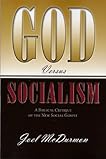
Review: God Versus Socialism (Joel McDurmon)

God Versus SocialismGod Versus Socialism by Joel Mcdurmon

My rating: 4 of 5 stars


McDurmon does an excellent job laying out the basics of socialistic thought, and in names and exposing the major players in the "social gospel" movement over the past hundred years; especially those most active today.
This book has shown that these issues did not die with the previous era of socialism/communism versus the free world. They did not fall silent when they fell. They remain as relevant as ever, especially with the reinvigoration of socialist ideology in government, including radical activists in Congress, the Judiciary, labor unions, teachers' unions, universities, and numerous posts in the White House itself, including the Presidency. The arguments of socialism resound throughout America like never before, and Christians must both discern their persuasive but devious rhetoric and stand firm with a biblical answer. The answers to socialism are, "The king is not God," and "Thou Shalt Not Steal." If Christians refuse to apply these principles to government, law, and economics, then we will move closer to the socialists' vision for society. We will have more of Marx than Moses, more of Trotsky than Christ." (pg 226-227)
Wielding the sharp sword of truth, McDurmon cuts through and destroys the fallacious teachings of modern day social gospel pundits Tony Campolo, Ron Sider, and Jim Wallis. His excellent dealing with Campolo's "red letter Christian" teachings is a highlight, as he shows that verse after verse they misuse and abuse Scripture in an attempt to force it to fit their agenda.
Campolo, like Wallis and Sider, loves to point out how "there are more than 2,000 verses of Scripture that calls us to express love and justice for those who are poor and oppressed..." But he immediately makes the unwarranted jump from the Bible's mandate for personal compassion to socialist government action: "we promote legislation that turns biblical imperatives into social policy." ... Gary DeMar responds appropriately, "What Campolo needs to find in these 2,000 verse is one verse that gives authority to civil government to redistribute wealth. Campolo takes verses that are directed at individuals and turns them on their head and gives them a political twist." (pg 134-135)
I could go on quoting more quotes (you should see how many highlights I have in this), but instead, let me encourage others to read and take heed. It is not full of high thinking economic garbaly-gook or political speak, but it is written in easy to understand terms. If you are new to political issues, socialism in general, or social justice/social gospel issues, this is a great place to start. highly recommended.


View all my reviews

18 October 2010

Review: A Praying Life

A Praying LifeA Praying Life by Paul E. Miller

My rating: 4 of 5 stars


This book changed my prayer life, by coming at a time in my life when I was in need, when I was down, and when even prayer seemed "distant" to me. Being raised most of my adult life within the framework of a pretty hard-core Reformed faith that put such a high value on reverence and fear before God, it must have worked in a way that made me forget the Father/son relationship that our heavenly father has with us. This book, in a nutshell, helped me change my thoughts from a awe-inspiring, big fearful fiery God to whom we approach (yes, he is those things), into a needy son who can't make it on his own and who has to come to his Father for everything little thing just to make it through each day.